
Authors:
Historic Era: Era 9: Postwar United States (1945 to early 1970s)
Historic Theme:
Subject:
Winter 2026 | Volume 71, Issue 1


Authors: Raymond Arsenault
Historic Era: Era 9: Postwar United States (1945 to early 1970s)
Historic Theme:
Subject:
Winter 2026 | Volume 71, Issue 1

After surviving a brutal beating during the 1965 voting rights march from Selma to Montgomery, John Lewis went on to serve 17 terms in Congress.
Winter 2026 | Volume 71, Issue 1
Editor’s Note: Raymond Arsenault is a professor of history emeritus at the University of South Florida and the author of the first full-length biography of the Civil Rights leader and Congressman, John Lewis: In Search of the Beloved Community, in which parts of this essay appeared. It was a New Yorker “Best Book of 2024” Selection.
John Robert Lewis traveled a great distance during his eighty years, moving from poverty to protest to politics. It is little wonder that his extraordinary journey from the cotton fields of Alabama’s Black Belt to the front lines of the civil rights movement to the halls of Congress became the stuff of legend. Considering his beginnings in a static rural society seemingly impervious to change and mobility, the arc of his life had an almost surreal trajectory, even though the obstacles he encountered along the way were all too real.
In this regard, Lewis merits comparison with the great nineteenth-century figure Frederick Douglass, who went from an enslaved laborer to a “radical outsider” as an abolitionist to a near “political insider” after the Civil War. Like Douglass, he transcended his humble origins with a fierce determination to change the world through activism and ceaseless struggle, ultimately finding a path to greatness that took him well beyond the limited horizons of Jim Crow culture.
During his years as a protest leader, from 1960 to 1966, Lewis evolved from student sit-in participant to Freedom Rider to one of the nation’s most visible voting rights advocates. By 1963, “the boy from Troy,” as he was often called, had become chairman of the Student Nonviolent Coordinating Committee (SNCC) and the youngest member of the civil rights movement’s so-called Big Six, joining A. Philip Randolph of the March on Washington movement, Roy Wilkins of the NAACP, Martin Luther King Jr. of the Southern Christian Leadership Conference (SCLC), James Farmer of the Congress of Racial Equality (CORE), and Whitney Young of the National Urban League.
Among these leaders, Lewis stood out as the one most likely to put his body on the line, to have a bandage on his head, or to find himself behind bars. Within movement circles, he earned an unrivaled reputation for physical courage, enduring more than forty arrests and nearly as many assaults. Decades later as a congressman, he would urge his followers to make what he called “good trouble,” a fitting rallying cry for a leader who as a young man repeatedly demonstrated his willingness to shed “a little blood to help redeem the soul of America.”
That he did so
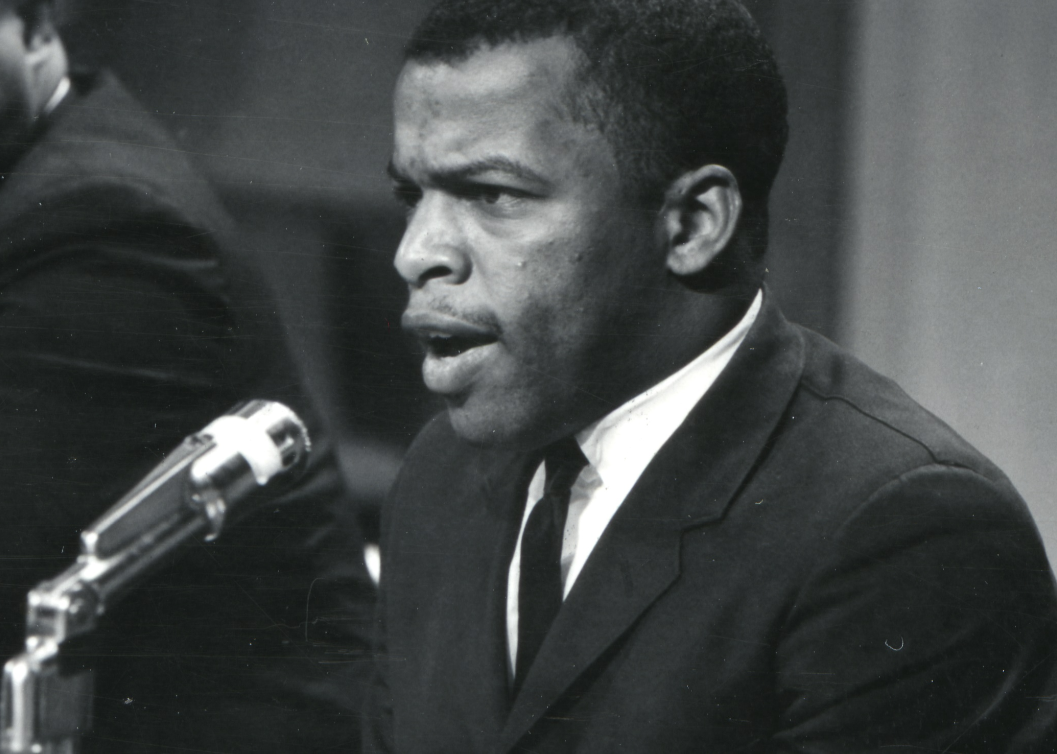
Lewis’s status as a fearless nonviolent warrior was a major source of his fame. But he also drew considerable acclaim for his steadfast commitment to the moral elevation of humanity. Many observers, both inside and outside the movement, characterized him as “saintly,” particularly during his years as a congressman, when moral and spiritual pronouncements punctuated his public speeches. His pleas for mercy, peace, love, forgiveness, and reconciliation stood out in a political system dominated by partisan rhetoric, intense competition, and interest-group politics.
In Washington, where talk of civil rights was often shallow and abstract, Lewis took full advantage of his experiences as a freedom fighter, bringing into play the spirit of a nonviolent movement enveloped in Christian and Gandhian ideals. Invoking powerful historical images of communal responsibility and common decency, he spoke with authority about rising above self-interest and doing the right thing, especially on matters of racial inequality and discrimination. Eventually, he won recognition as “the conscience of Congress,” a scrupulous champion of honesty and moral rectitude.
As a protest leader in the early 60s, Lewis was given many chances to prove his commitment to nonviolence, but never so clearly as during the voting rights struggle in Selma. For nearly two years, the central Alabama project that Civil Rights leaders initiated in January 1963 met with stiff resistance from the white supremacist political and law enforcement leaders of Selma and the surrounding Black Belt counties. This project was the kind of grassroots campaign that Lewis and many of his SNCC colleagues had been encouraging since the organization’s founding five years earlier.
When the first Selma march commenced on January 18, Lewis walked alongside Dr. King with his head held high, confident the movement that had experienced dissension and disappointment during the previous six months was entering a new stage of solidarity. SNCC’s foot soldiers, more than four hundred strong that day, gave him renewed hope that he and his fellow activists would indeed, in the words of the movement’s anthem, “overcome,” regardless of how intransigent or violent their opponents might be.
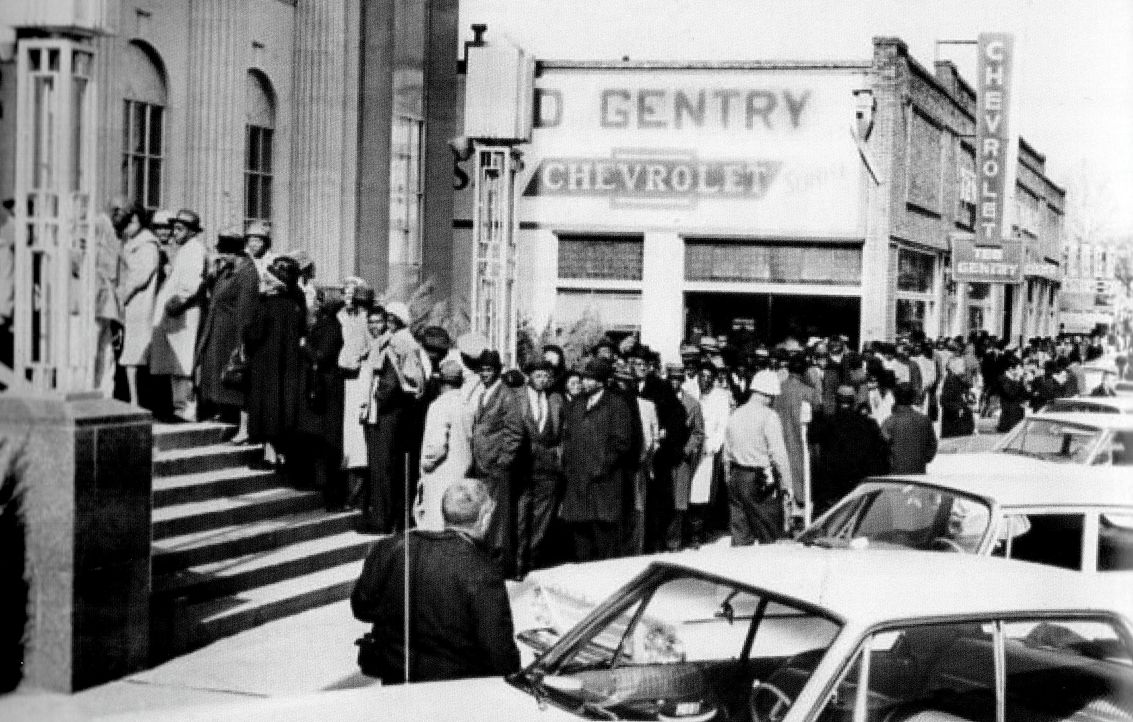
As expected, on the day of the first march, the white supremacist opposition surrounding the Dallas County Courthouse steps was daunting, made up not only of locals but also of
After several hours of waiting to be admitted to the voter registration office, the marchers withdrew, mercifully without suffering any physical attacks or injuries. “No one was let into the courthouse,” Lewis remembered, “No one was registered to vote. But the line had been drawn, and that was enough.”
The violence came later that afternoon when Dr. King tried to breach the color bar at the previously whites-only Hotel Albert. As King signed the register as the hotel’s “first-ever Black guest,” Jimmy George Robinson, a member of the militantly white supremacist National States Rights Party, lunged at the civil rights leader and began wildly kicking and punching him. Standing nearby, Lewis responded instinctively, grabbing Robinson and immobilizing him with a bear hug. This rush to King’s defense, Lewis later confessed, was one of the strangest experiences of his life. “I’m not a physical person,” he explained. “I’ve never been in a fight in my life. I’ve been hit — many, many times — but I’ve never hit back. At that moment, though, something shot up in me, something protective, something instinctive.”
Lewis’s commitment to nonviolence would be tested almost daily during the two weeks that followed. As the courthouse marches continued, an exasperated Sheriff Clark responded with increasing harshness, ordering mass arrests and doling out punishment whenever his anger got the best of him. On the second day of marching, as national news reporters looked on, Clark grabbed fifty-three-year-old Amelia Boynton “by the back of her collar and pushed her roughly half a block into a patrol car.” One of the most revered members of Selma’s Black community and the mother of Bruce Boynton, the plaintiff in the 1960 Boynton v. Virginia case that helped trigger the Freedom Rides, she ended up in jail, as did sixty-seven other protesters, including Lewis, the following day. Lewis spent the next five nights at a county work farm on the outskirts of the city as the daily downtown marches continued.
Later in the week, Lewis traveled to the West Coast for several days of much-needed fundraising. During his absence, King was arrested along with 250 other marchers, and later in the day 500 Selma schoolchildren joined them behind bars. Over the next two days, Clark arrested several hundred more students, escalating a crisis that was clearly
More evidence of Clark’s violent style of intimidation surfaced on February 16, when Lewis led a group of twenty-five protesters to the courthouse. In the front line standing on the steps was the Reverend C. T. Vivian, a former Freedom Rider and Lewis’s old friend from Nashville, who confronted Clark and his deputies with bold words. “You’re racists the same way Hitler was a racist!” Vivian declared, before daring Clark to hit him. Avoiding several deputies who stepped in to block their boss from taking “the bait,” Clark lunged forward, punching Vivian in the mouth so hard that he broke a finger in the process. Bloodied, Vivian tumbled down the steps before being arrested and carted away.
Vivian was released the next day, and that evening King delivered a fiery speech at Brown Chapel calling for increased militancy, including nighttime marches and an expansion of SCLC-sponsored demonstrations to towns in neighboring counties. Local white officials asked Governor George Wallace to dispatch state troopers to the town. By the morning of February 18, when the troopers arrived and made arrests, the stage was set for a major confrontation.
After 450 Black protesters gathered at Marion’s Zion Methodist Church that evening to hear Vivian and another SCLC staff member, speak, the crowd began a march to the city jail to serenade Rev. James Orange with freedom songs. But before they had marched a block, a force of troopers and local police, plus Clark and several of his deputies, ordered them to return to the church. Seconds later, however, after one of the marchers knelt to pray, the law enforcement officers started beating them indiscriminately.
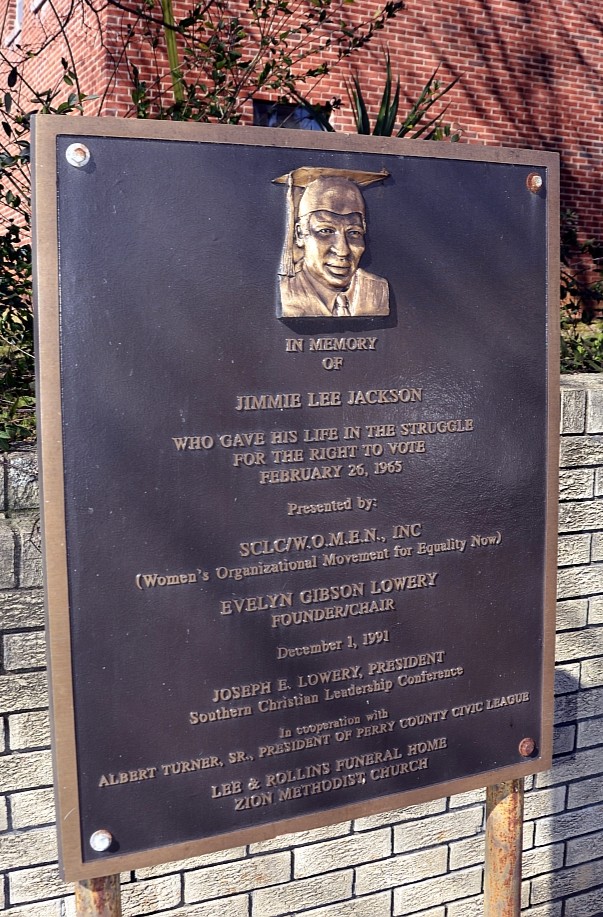
Jimmie Lee Jackson, a twenty-six-year-old army veteran, tried to flee from the assault, running alongside his grandfather, who had been struck in the head. They thought they had found refuge at the nearby Mack’s Café, where Jackson’s mother worked, but the state troopers pursued them into the café, where they assaulted several patrons and Jackson’s mother. When Jackson tried to shield his mother from further harm, a state trooper named James Fowler shot him twice in the abdomen. Jackson staggered into the street and collapsed on the pavement, where he remained bleeding and gasping for breath for thirty minutes before local police took him to a county infirmary. He would die eight days later, on February 26. By
Jimmie Lee Jackson’s funeral was held on the last day of February in a small church in Marion, with four hundred mourners inside the sanctuary and six hundred more standing in the rain outside. The memorialization of the first person to die as a result of the white resistance to the Selma campaign led Lewis and many others to the edge of despair. After eulogies by King and James Bevel, the mourners walked down a dirt road to the cemetery where Jackson was laid to rest. During what turned out to be a fateful procession, Bevel came up with a daring plan to carry Jackson’s body all the way to Montgomery. The idea was to “walk the entire fifty-four miles from Selma and lay this young man’s casket on the capitol steps,” Lewis later summarized. “Confront the governor. Confront the state of Alabama. Give them something they couldn’t turn their heads away from.”
During a series of meetings held over the next four days, Bevel’s idea “caught fire” among the SCLC’s leaders, including King, but other than Lewis, SNCC wanted no part of it. Jim Forman argued the proposed march would be too risky and do little or nothing for the mass of disfranchised people in central Alabama. But the SCLC would not be deterred as Bevel announced on March 3 that a march led by Dr. King would leave Selma for Montgomery the following Sunday. In response, Forman sent a protest letter to King bearing Lewis’s signature. “We strongly believe that the objectives of the march do not justify the dangers,” the letter stated, “. . . consequently the Student Nonviolent Coordinating Committee will only live up to those minimal commitments . . . to provide radios and cars, doctors and nurses, and nothing beyond that.”
Lewis strongly disagreed with his organization’s withdrawal and said so at a SNCC executive committee meeting in Atlanta later in the week. Unable to convince his colleagues that SNCC had a moral obligation to participate in the march, he nonetheless declared his intention to be involved. “I grew up in Alabama.” he explained. “I feel a deep kinship with the people there on a lot of levels. You know I have been to Selma many, many times. I’ve been arrested there. I’ve been jailed there. If these people want to march, I’m going to march with them. You decide what you want to do, but I’m going to march.”
Just after the meeting closed around midnight, Lewis joined two colleagues, Bob Mants and Wilson Brown, for the four-hour drive to Selma. It was now the day of the march, Sunday, March 7, and after a few hours
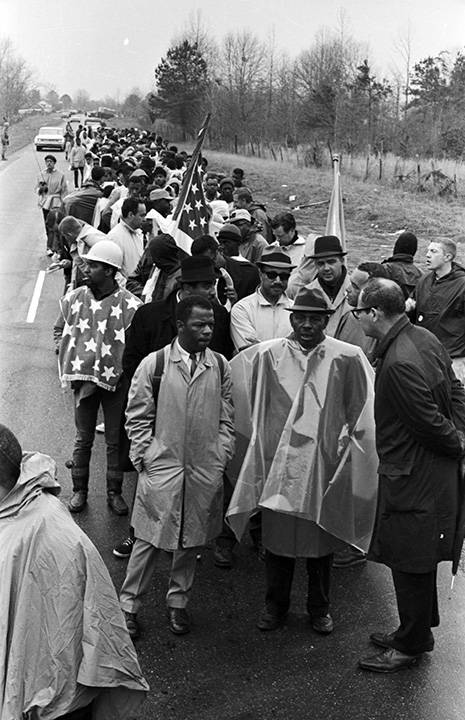
It was later revealed that King’s absence was also a response to a series of death threats that had surfaced during the past week, but whatever his motivation, neither he nor Young, nor anyone else in the SCLC, had the power to delay the march. The people of Selma, it became clear on that fateful afternoon, were going to march, with or without the SCLC’s blessing.
After King was informed there was no way to stop the march from going forward as originally planned, he instructed Young to choose himself, Bevel, or Williams to join Lewis as coleader of the march. A coin toss soon put Williams on the front line with Lewis, and by midafternoon the assembled mass was ready to head eastward out of town across the Edmund Pettus Bridge and down Highway 80 to Montgomery.
At that point, no one knew how far they would actually march on the first day, or what resistance they would encounter along the way. “We expected a confrontation,” Lewis remembered. “We knew Sheriff Clark had issued yet another call the evening before for even more deputies. Mass arrests would probably be made. There might be injuries. Most likely, we would be stopped at the edge of the city limits, arrested and maybe roughed up a little bit. We did not expect anything worse than that.”
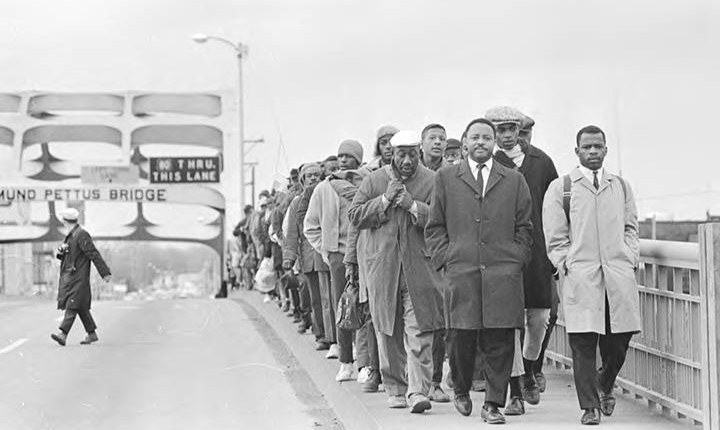
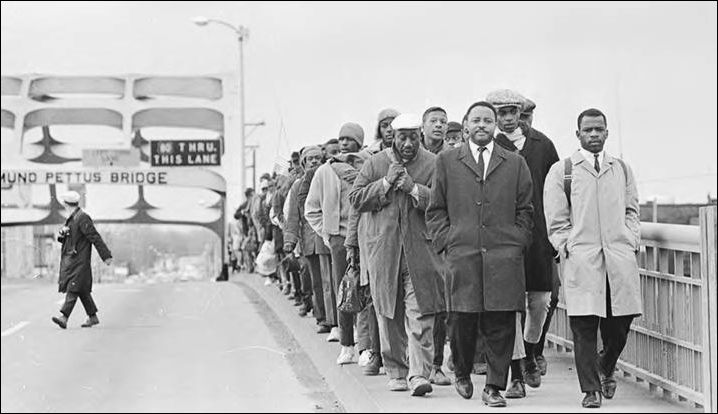
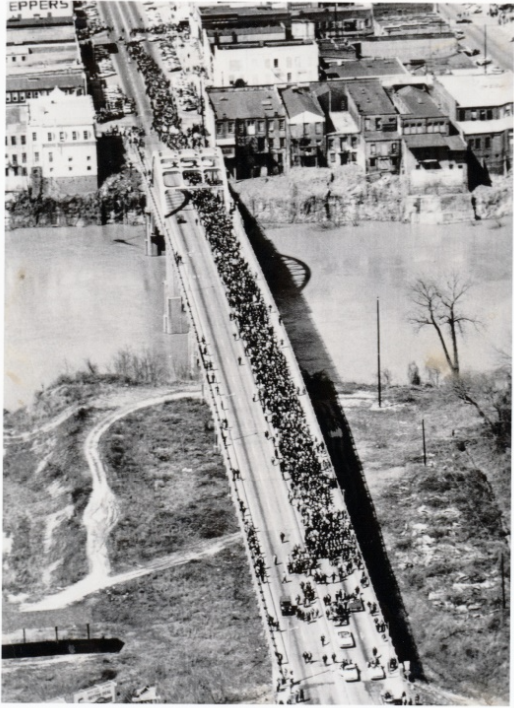
Before leaving the church grounds, Lewis acknowledged the reporters present by reading a short statement about why the march was important. The assemblage then bowed their heads and knelt on one knee as Young offered a prayer. And then they were off, walking two abreast past the all-Black Carver housing project and down Water Street to the bridge crossing the river. With Lewis and Williams leading the way, the marchers grew silent as they passed by a surly group of armed white men standing in front of the city newspaper office.
Turning onto a narrow sidewalk, they crossed over the west side of the bridge until they reached the peak in the middle, stopping first to look down at the water below and then east toward the end of the bridge,
Standing a hundred feet above the mud-colored river, Williams gulped and asked Lewis if he could swim. Lewis said no, and Williams confessed that neither could he. So with no safe route of escape and hundreds of marchers trailing behind them, they had no choice but to move forward to the end of the bridge, where Major John Cloud of the state police was standing holding a bullhorn.
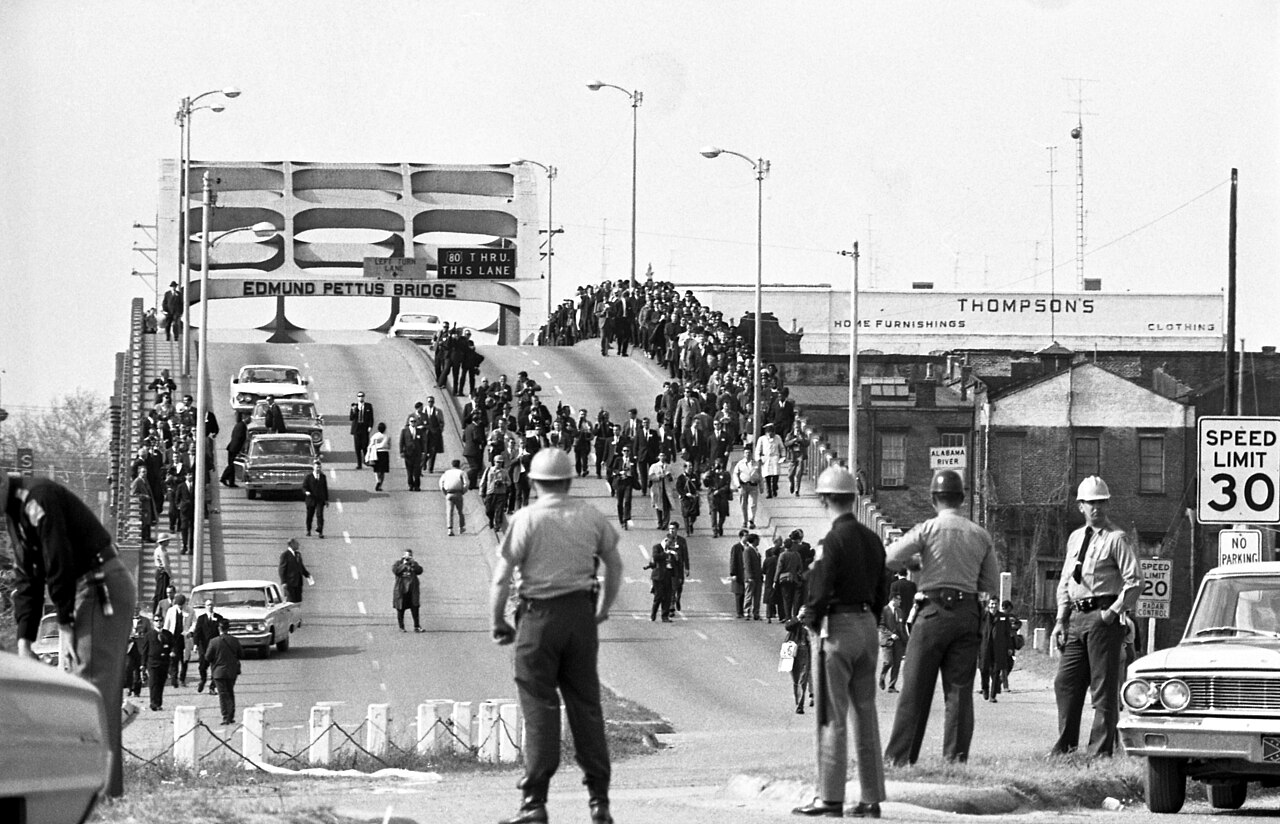
“This is an unlawful assembly,” Cloud bellowed. “Your march is not conducive to the public safety. You are ordered to disperse and go back to your church or to your homes.” When Williams asked to have a word with the major, the response was, “There is no word to be had.”
Mayor Cloud then gave them two minutes to turn around and disperse, but complying was all but impossible. Lewis suggested that they all kneel in place and pray, but before the idea could be acted on, less than a minute after Cloud’s warning, the troopers were ordered to advance.
The mayhem that followed would be seared in Lewis’s memory, and in the memories of the millions of Americans who watched the videotape of what became known as Bloody Sunday. “The troopers and possemen swept forward as one,” Lewis remembered, “like a human wave, a blur of blue shirts and billy clubs and bullwhips. We had no chance to turn and retreat. There were six hundred people behind us, bridge railings to either side and the river below. I remember how vivid the sounds were as the troopers rushed toward us-the clunks of the troopers’ heavy boots, the whoops of rebel yells from the white onlookers, the clip-clop of horses’ hooves hitting the hard asphalt of the highway, the voice of a woman shouting, ‘Get ‘em! Get the niggers!”
Lewis was one of the first to go down, clubbed on the left side of his head by a burly trooper. “I didn’t feel any pain,” he later insisted, “just the thud of the blow, and my legs giving way. I raised an arm – a reflex motion – as I curled up in the ‘prayer for protection’ position. And then the same trooper hit me again. And everything started to spin.” As
Choking and coughing, Lewis slid into nausea and an eerie, out-of-body feeling: “I remember how strangely calm I felt as I thought, This is it. People are going to die here. I’m going to die here.” Though no one actually died as a result of the assault, many were struck down or trampled as the marchers retreated in terror. Thirteen, including Lewis, would require hospitalization, and scores of others suffered serious injuries both physical and psychological.
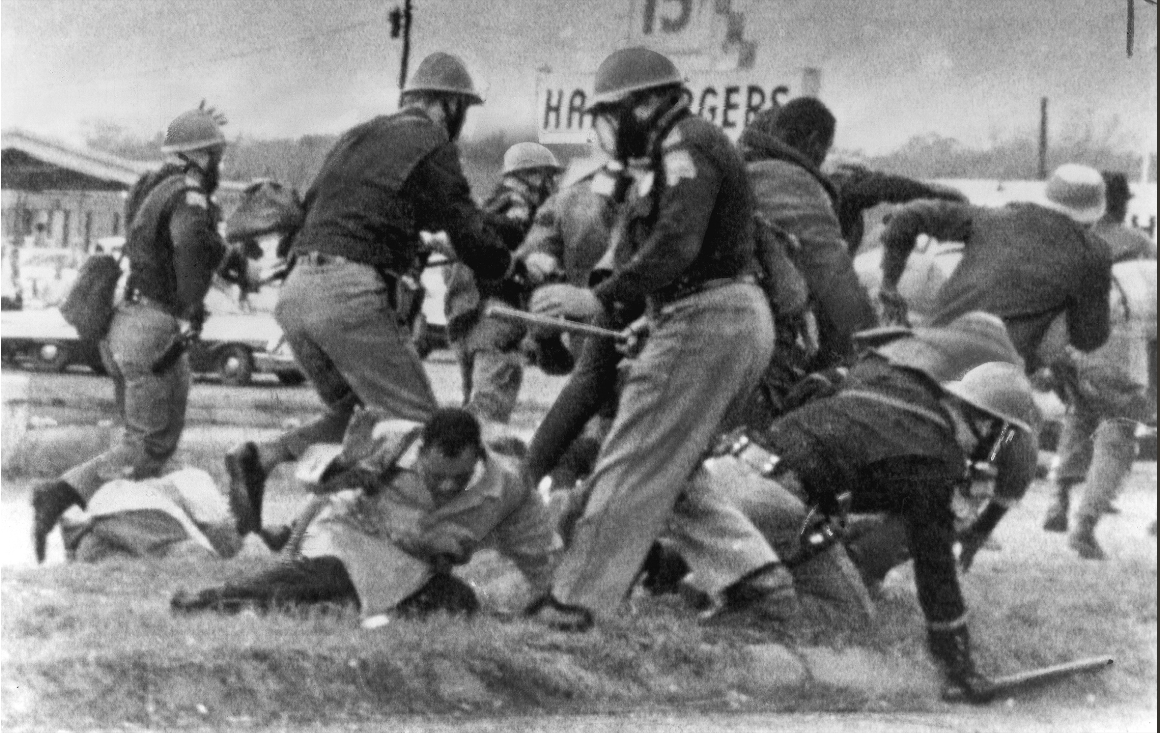
As Roy Reed of the New York Times described the scene on the bridge, “The first 10 or 20 Negroes were swept to the ground screaming, arms and legs flying. Those still on their feet retreated. The troopers continued pushing, using both the force of their bodies and the prodding of their night-sticks. A cheer went up from the white spectators lining the south side of the highway. The mounted possemen spurred their horses and rode at a run into the retreating mass. The Negroes cried out as they crowded together for protection, and the whites on the sidelines whooped and cheered.”
From inside the melee, Lewis regained enough consciousness to witness some of the worst of the carnage. “There was mayhem all around me,” he recalled years later. “I could see a young kid – a teenaged boy – sitting on the ground with a gaping cut in his head, the blood just gushing out. Several women, including Mrs. Boynton, were lying on the pavement and the grass median. People were weeping. Some were vomiting from the tear gas. Men on horses were moving in all directions, purposely riding over the top of fallen people, bringing their animals’ hooves down on the shoulders, stomachs and legs. The mob of white onlookers had joined in now, jumping cameramen and reporters.”
The brutal pursuit continued for several agonizing minutes. “I was up now and moving back across the bridge, with troopers and possemen and other retreating marchers all around me,” Lewis remembered. “With nightsticks and whips – one posseman had a rubber hose wrapped with barbed wire – Sheriff Clark’s deputies chased us all the way back into the Carver project and up to the front of Brown Chapel, where we tried getting as many people as we could inside the church to safety. I don’t even recall how I made it that far, how I got from the bridge to the church, but I did.”
Both on the church grounds and in nearby streets, the assault continued for half an
Soon a group of angry Black men and women “collected in front of the church, with SNCC and SCLC staff members moving through and trying to keep them calm. Some men in the crowd spoke of going home to get guns. Our people tried talking them down, getting them calm.” Meanwhile, “kids and teenagers continued throwing rocks and bricks.” As ambulances shuttled between the church and Good Samaritan Hospital, a Catholic facility staffed mostly by Black doctors and nurses, several friends urged Lewis to join the wounded at the hospital. But he refused and remained on site into the evening, when he and Williams convened a mass meeting in Brown Chapel.
Although a band of state troopers continued to surround the church, more than six hundred souls – including a number of heavily bandaged survivors of the afternoon assault – packed the sanctuary to listen to what the march’s leaders had to say. After Williams offered a few words to calm the crowd, Lewis – with his head “throbbing” and his hair “matted with blood,” and still wearing a trench coat “stained with dirt and blood” – made his way to the pulpit.
“I don’t know how President Johnson can send troops to Vietnam” and other parts of the world, Lewis declared, yet “he can’t send troops to Selma, Alabama.” Hearing cries of ‘‘Yes! and Amen,” he went on to predict, “Next time we march, we may have to keep going when we get to Montgomery. We may have to go on to Washington.” This bold statement, which appeared in the New York Times the next morning, elicited a prompt response from the Justice Department, which pledged to send FBI agents to Selma to investigate whether law enforcement officers and others had used “unnecessary force” to block the march to Montgomery.
Lewis was then taken to Good Samaritan, where X-rays revealed he had suffered a fractured skull and a severe concussion. Admitted for observation and treatment, he was resting in his hospital room when the ABC television network shocked its viewers that evening with a special fifteen-minute news bulletin showing extended film footage of the savage attack on the marchers. Wedged in between sections of the movie Judgment at Nuremberg, the footage as shown had a surrealistic quality that left many Americans wondering if what they were watching was real. It was, of course, all too real, including a film clip in which Sheriff Clark could be heard screaming, “Get those goddamned niggers. And
On March 21, following an outpouring of support from across the nation and a second march that was turned around at the bridge, the final march from Selma to Montgomery began. Lewis would join the march each day but be transported back to Selma at night, per an arrangement with his doctors, who feared that five nights of sleeping on hard ground along the route would be too much of a strain on his precarious health. On March 25, after five days of marching, Lewis and nearly forty thousand others walked the six miles from St. Jude to the Alabama State Capitol, where Lewis “could see the Alabama state flag flying high above the rotunda dome, along with the flag of the Confederacy. But the American flag was nowhere in sight. Neither was George Wallace, though we learned later that he watched the entire afternoon, peeking out through the drawn blinds of the governor’s office.”
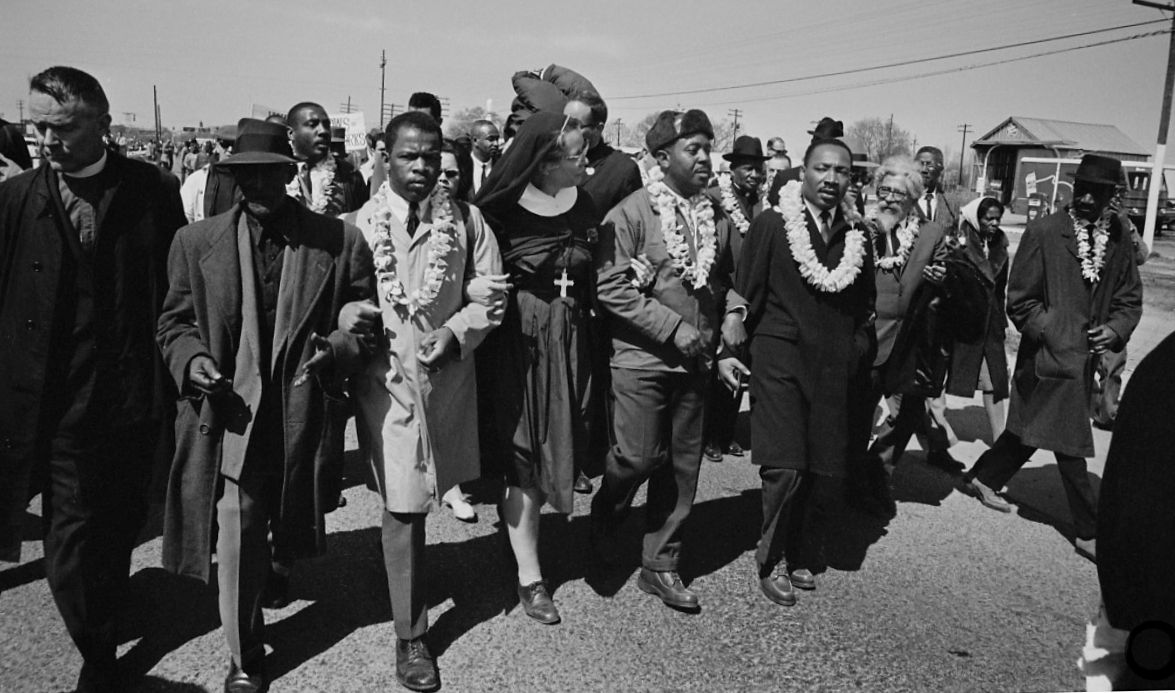
What Wallace witnessed that afternoon must have shaken his confidence. After nearly a century and a half of racial discrimination and Black disfranchisement, “We the People” had finally arrived in Montgomery to serve notice that a new day of democracy was dawning. With the crowd blanketing several blocks west of the capitol, a procession of orators ranging from Farmer, Bayard Rustin, and Rosa Parks to Bevel, Lewis, and King held forth on the meaning of the march. King, who spoke last, delivered what Lewis and many others regarded as one of the greatest speeches of his career. His eloquence reached a climax in a final burst of words, some borrowed from “The Battle Hymn of the Republic.” “How long will justice be crucified and buried?” he asked. “I come to say to you this afternoon, however difficult the moment, however frustrating the hour, it will not be long. Because truth crushed to earth will rise again.”
After Bloody Sunday and the Selma marches, Lewis continued his leadership on civil rights at the SNCC and later on the Atlanta City Council, where he served for six years. In 1986, he was elected to the U.S. House of Representatives as a Democrat representing Georgia’s 5th Congressional District. For the most part, he felt like he was in good company surrounded by bright and accomplished colleagues. But among the newcomers, he and Mike Espy were the only veterans of the civil rights struggle, an obvious fact publicized by the press. Everyone in the House seemed to be aware of his background — from his many arrests and beatings to his
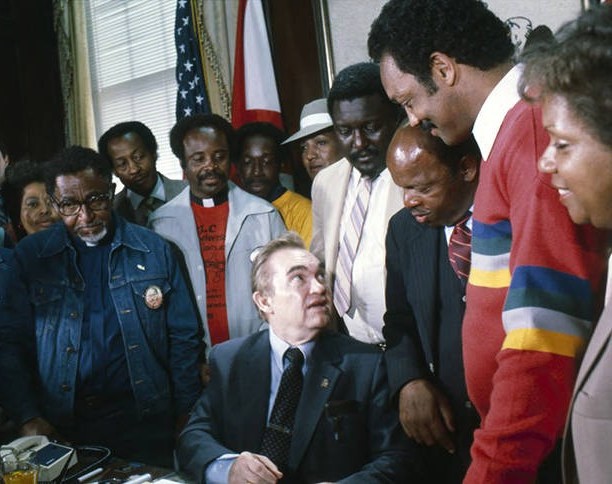
Lewis never encouraged such characterizations, which he found embarrassing. But he did not shy away from his identification with the civil rights movement. “I came to Congress with a legacy to uphold,” he later explained, “with a commitment to carry on the spirit, the goals and the principles of nonviolence, social action and a truly interracial democracy.” He wasn’t naïve; he knew it wasn’t going to be easy to apply his passion for social justice and racial equality to the workings of Congress, where tradition, partisanship, and self-interest generally held sway.
Yet from his first days as a congressman, Lewis set out to remind his colleagues that the government’s “first concern should be the basic needs of its citizens — not just black Americans but all Americans — for food, shelter, health care, education, jobs, livable incomes and the opportunity to realize their full potential as individual people.”
As a congressman, Lewis became adept at practical politics and the art of compromise. But somehow he always kept his eyes on the prize, which for him was the realization of the Beloved Community. Unlike most political leaders, he did not allow his vision of a better future to be diverted by the pursuit of competitive advantage or parochial interests. If this sometimes made it more difficult to get things done — to pass legislation or advance his constituents’ interests — he accepted the trade-off because he believed he was in office to serve a higher purpose. If forced to choose, he was willing to sacrifice short-term gains for the sake of long-term objectives. As in his movement days, Lewis’s determination to live up to his reputation for moral rectitude guided the logic of his politics.
Through it all, his moral sensibility remained universalistic and utopian, with a steady focus on the behavior and beliefs that would elevate humankind to a higher moral plane: integrity, compassion, generosity, forgiveness, reconciliation — and above all, respect for human dignity.
As one of the nation’s leading exponents of the democratic ethos, Lewis worked tirelessly to protect the rights of all Americans to “Life, Liberty and the pursuit of Happiness,” as articulated in the Declaration of Independence in 1776. True to form, the hero of Nashville, Montgomery,
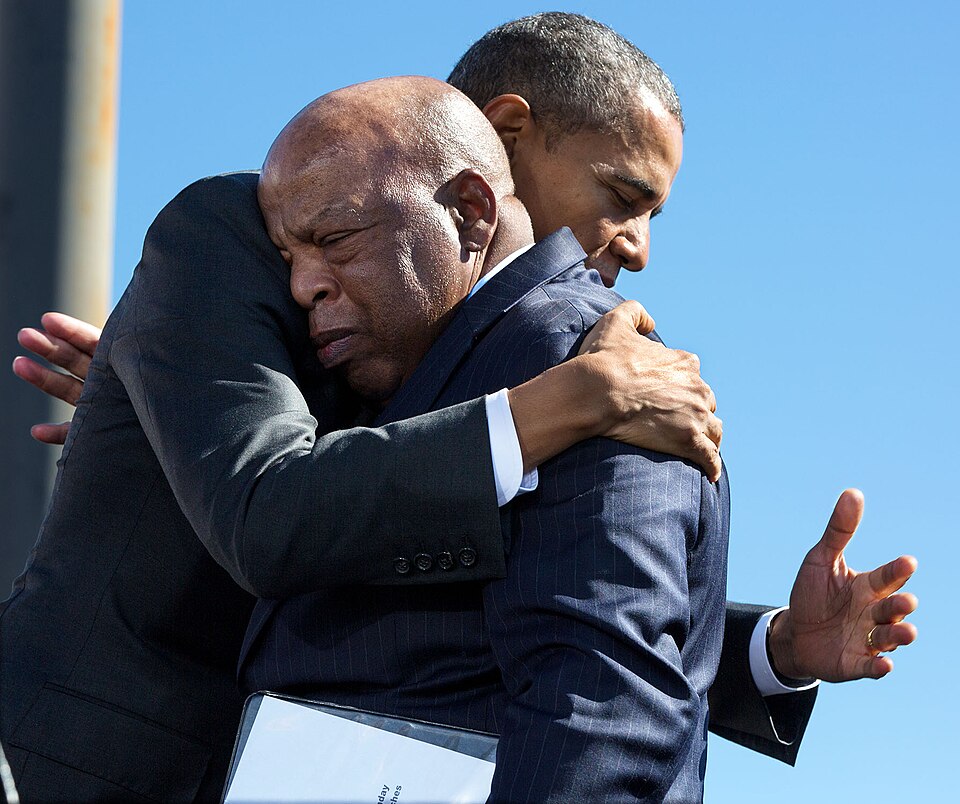
For the last three and a half years of his life — until his death in July 2020 — the great civil rights champion, bloodied but unbowed, continued to stand up for freedom and equality with every fiber of his being. This courageous effort put the final touches on an inspiring legacy that gave hope to the millions of Americans determined to carry on his struggle. Lewis was gone, but the spirit of “good trouble” — a phrase that had become synonymous with his style of activism — survived as a vital form of resistance and a potentially powerful force for democratic renewal.
The outpouring of grief and the profound sense of loss that followed Lewis’s death testified to his unparalleled reputation as a man of courage and conscience. No member of the House, Democrat or Republican, had been accorded such an emotional and reverential send-off in living memory. In October 2019, Elijah Cummings became the first Black member of Congress to be accorded the honor of lying in state at the Capitol, in his case in the National Statuary Hall, and now Lewis became the second in the Capitol and the first in the Rotunda. “Lying in state is part of the celebration of the life of a great American,” argued Al Green, a Congressman from Texas who had twice joined Lewis in jail, once in 2006 after protesting genocide in the Sudan and again in 2013 after rallying for immigration reform. “He was not an ordinary person. He would not agree with me saying that, but he was not. To love the way he loved? To take what he took on the Edmund Pettus Bridge and still preach love? You’re not an ordinary person.”
Standing at the pulpit in front of an overflow crowd at the memorial for Lewis, Bill Clinton and George W. Bush expressed their admiration for one of twentieth-century America’s greatest public figures, a unique moral and political leader who fought for democracy and human rights both in the streets and in the halls of Congress. Both Clinton and Bush offered eloquent and moving tributes, but the most powerful and memorable eulogy came from Barack Obama.
In the hope of advancing this lifelong struggle, Lewis did all he could to leave a legacy that would benefit future generations. Even during his cancer treatment in early 2020, when he was weak and often racked with pain, he took the time to collaborate with two of his aides, Michael Collins and Kabir
In the final essay, titled “On the Future,” Lewis offered a 125-word epitaph as a vessel of hope: “We have made progress over the past many decades. Dr. King and the civil rights movement birthed a committed new generation of activists who are imagining, envisioning, and shaping the world they want to see. One hundred years from now, I would love to see that our Beloved Community, the place we call home – America – will be more at peace with itself. Let us hope and believe that there will be less turmoil, less rancor, less violence. America should be a place of respect and dignity, a beacon of light for all of our fellow human beings. I know it is within our power to make such a world exist. Be patient. Be hopeful. Be humble. Be bold. Be better. Keep the faith. Carry on.”