Authors:
Historic Era: Era 3: Revolution and the New Nation (1754-1820s)
Historic Theme:
Subject:
Winter 2026 | Volume 71, Issue 1


Authors: Eric Lane, Michael Oreskes
Historic Era: Era 3: Revolution and the New Nation (1754-1820s)
Historic Theme:
Subject:
Winter 2026 | Volume 71, Issue 1


America’s extraordinary success is directly related to its unique form of government embodied in the Constitution.
Winter 2026 | Volume 71, Issue 1
Editor's Note: Eric Lane is a professor of constitutional and public law at Hofstra University and the author of three books. Michael Oreskes held senior editorial positions at The New York Times and the Associated Press before joining NPR as senior vice president of news. Together they published The Genius of America: How the Constitution Saved Our Country – and Why It Can Again which looked at the document that made our country the longest surviving democracy in the history of civilization. Portions of this essay appeared in that book.
The United States of America is an extraordinary accomplishment – the richest, most powerful nation that has ever existed. From a handful of farmers and merchants on the edge of the known world, it has grown, endured, agonized and prospered. Millions have flocked to its shores, and millions more continuously hope to come.
Saying that this has become something of a cliché does not make it any less true. Nor does the fact that some people in other parts of the world have come to resent the way America asserts its wealth and power make America’s rise any less remarkable or significant. Even America’s fiercest critics don’t argue that.
But why did this success visit itself on the United States? Certainly it is a land blessed with enormous resources and intrepid people. They have been celebrated many times. But there are other nations with great resources and excellent people. What is so apparent is often underappreciated: America’s extraordinary success is directly related to its unique form of government. Not just to its freedom or its democracy, but to its singularly American form of democracy.
Indeed, one of America’s first and greatest inventions was the United States of America itself. This was something wholly new in the annals of government. There had been democracies before. There had been republics before. But what the Framers invented was something no one had ever seen before.
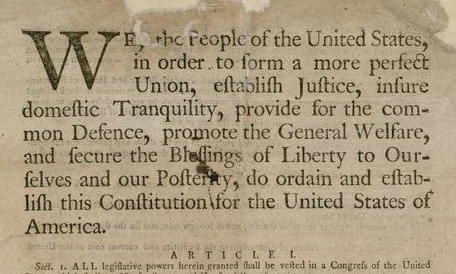
They built a system of government entirely self-contained. They looked to neither God nor king for higher authority. This was, as they said, a government of “We the people.” Every piece of it represented the people and drew its authority from the people, not, as for example in England, where the king or queen owed their power to the will of God, and the then powerful House of Lords to the lineage of
But for government of the people to really work, the Framers had to recognize what people were really like and then design a government around that reality. Through trial and spectacular error, they came to understand that anything less realistic was doomed to fail.
This, then, was their radical breakthrough: their recognition that government had to be designed around a cold-eyed acceptance of men as they really are, not as we might wish them to be. What was that cold-eyed view of human nature? They recognized that people pursue their own self-interests. And in this pursuit, they often regard what is good for them as good for all.
Other political thinkers had, of course, noticed this from time to time before the American Revolution. But before America, proponents of democracy (when they could be found) generally solved the problem of selfishness by suggesting that citizens could rise above their own interests to join in achieving some larger good that they would recognize through reasoning together.
This is an attractive thought. It was nice to believe — it is still nice to believe — that we each have this capacity for public virtue. Indeed, in the heady first days of the Revolution (but neither before nor after), the founders themselves by and large believed this. They generally thought that the simple act of breaking with England would free Americans in their new land from the corrupting values of the old world. In April of 1776, Tom Paine described America as “a blank sheet” on which a freed people could and would script a new start. All that was needed to make government work was virtuous Americans doing the right thing in their new land.
But in the first disastrous years of their independence they came to understand that they had been hopelessly naive. Of course, there were individual examples of self-sacrifice for the larger cause. Yet overall, the Framers found, the people could reliably be counted on to do what was best for themselves as individuals, not for some abstract larger whole. As a result, the people had nearly let their army starve in the field of battle. They had competed, one state against another, for the upper hand in trade. They had profiteered and stolen and refused to work together.
The American experiment in self-government was on the verge of failure.
“We have probably had too good an opinion of human nature in forming our confederation,” George Washington wrote in 1786.
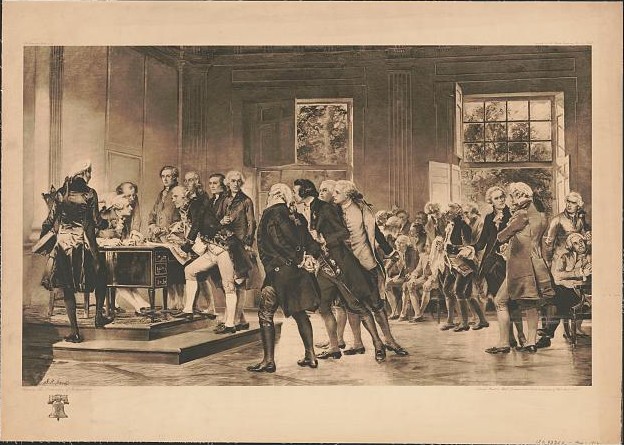
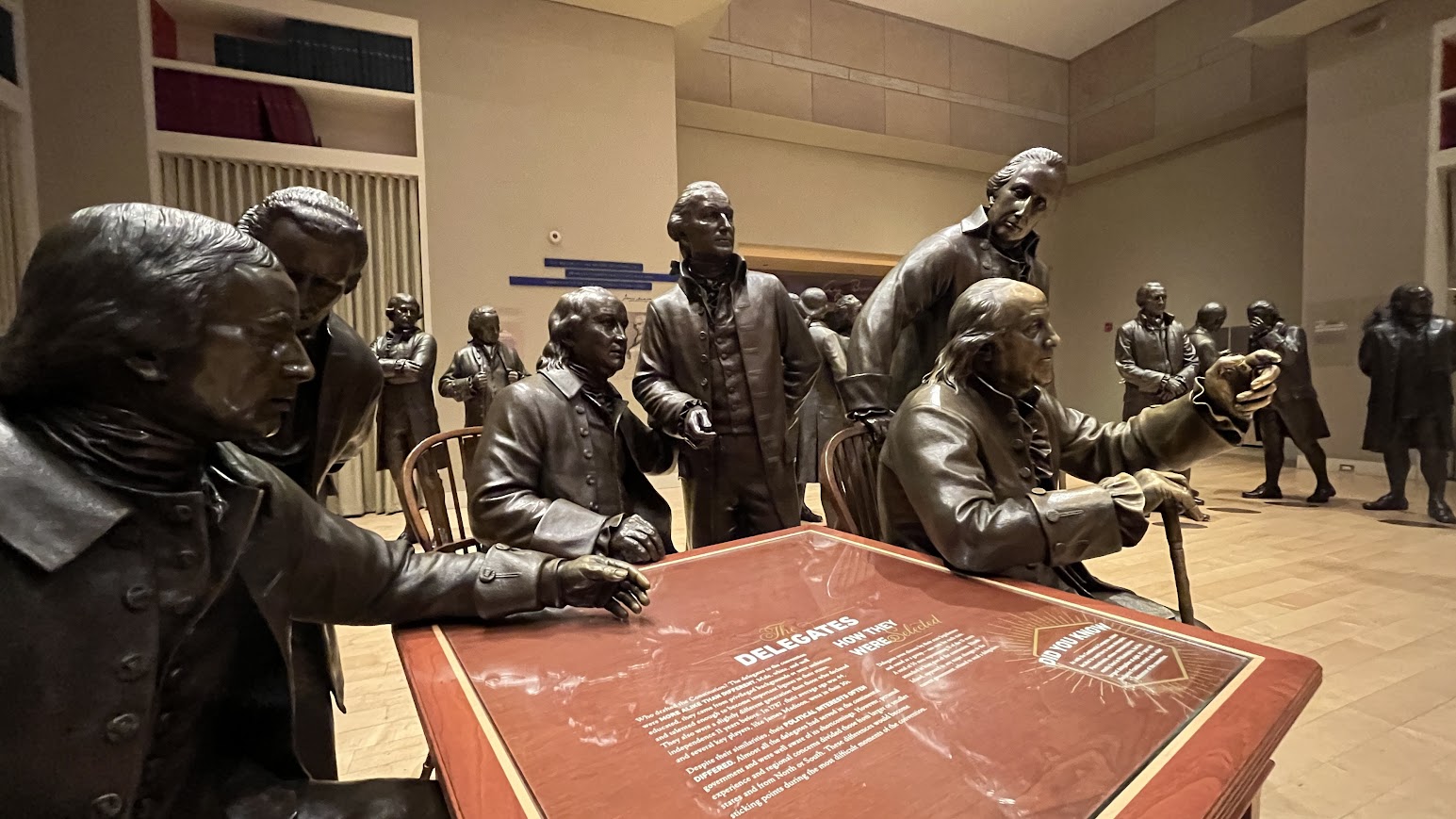
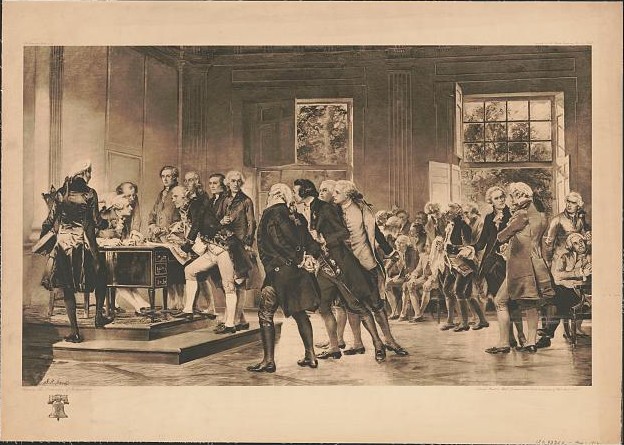
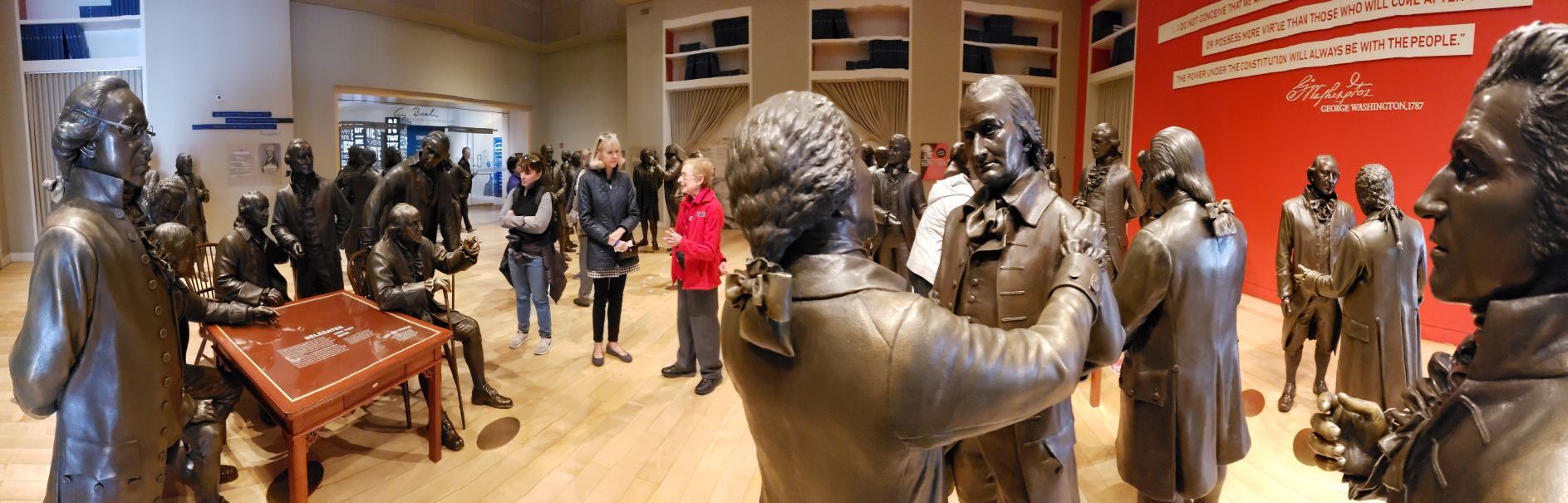
Then, a quintessentially American thing happened. A group of men, chosen by their states, got together in the sweltering late spring of 1787 to try to fix things. They locked themselves in a room and haggled and brokered and compromised. They went way beyond any instructions
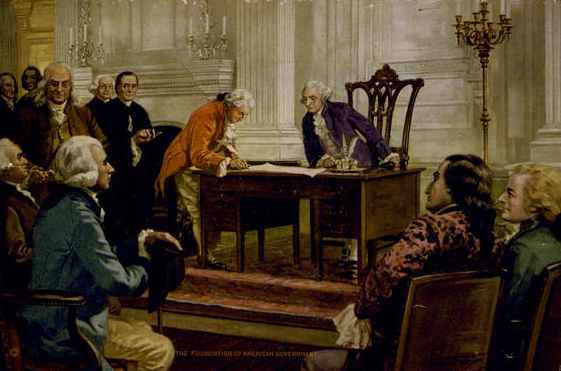
And out of that sweltering room in Philadelphia, out of that crisis of the early American nation, emerged a blueprint for government that was designed to let the people govern themselves despite their imperfections. They called it “this Constitution for The United States of America.” It did not count on people to be selfless or somehow bigger than themselves. “If men were angels, no government would be necessary,” wrote James Madison, one of the heroes of our story.
Indeed, the Constitution recognized that the great strength of Americans was their drive and ambition. For most, that is what got them to the new world (and still does). The Constitution would make a virtue of this “vice.” This new idea for government presumed that people would pursue their own interests. Indeed, it counted on them to do just that. And it created paths for others to disagree, and resist them, or argue for something different.
The Framers’ invention was a government designed to channel these struggles. To impede change until enough people supported it. To force people to the middle. To encourage compromise. To spread power around so that, in Alexander Hamilton’s succinct vision, the few could not oppress the many, and the many could not oppress the few. A lot could get done if people worked together in this system. But if they refused to compromise, it could all grind to a halt.
In other words, what they sent out from Philadelphia was more than just a piece of parchment. They created a set of ideas about government and democracy. Twenty years ago, the scholar Michael Kammen published a marvelous book on the Constitution in our culture. He described both the importance to us of the document itself and of the values and options that surrounded it, what he called constitutionalism. At the heart of constitutionalism is an acceptance of “conflict within consensus.” Conflict over issues, within a consensus that we are bound one to another by our shared belief in our Constitution and its principles.
This crucial tension has both held our country together and driven us forward. For conflict within consensus to be constructive, rather than destructive, Americans had to accept in their political bones several other ideas crucial to the Constitution. One was compromise. The Constitution was a set of compromises and assumed the vital need for compromise for the new government to function. Another crucial idea was representation. The political philosophy of the Framers assumed that Americans would accept compromises because they felt properly
All of the Constitution’s ideas taken together—conflict within consensus, compromise, representation, checks and balances, tolerance of debate—became part of the political conscience of each American. We therefore call this set of ideas, these core political values, the Constitutional Conscience.
Every nation has a set of political values. But ours are, by comparison, more vital to us, as Americans, than a similar set of values would be to the people of many other nations. Ours is not a country “defined by blood, clan, land origin or religious belief,” observed the journalist Ray Suarez. Indeed, said former Harvard president Derek Bok, “more than any other leading democracy, America is a country that preserves its unity through a shared belief in its Constitution, its institutions of government, and its democratic principles.”
So it is particularly important that we pay attention to our connection to our Constitution, institutions and principles. But in recent years Americans have been losing touch with some of these basic constitutional values, most particularly a commitment to compromise and a tolerance for competing ideas. To say it the way Professor Kammen might, conflict has been increasing, and consensus has frayed. Americans’ faith in their system is not what it once was.
“Our conviction about American greatness and purpose is not as strong today” is the way William J. Bennett describes it on the very first page of his history of the United States, The Last Best Hope. Bennett said he wrote his book in part to remind Americans of their debt of gratitude to those who built the country. We share that worthy goal. An antidote to our frustration and cynicism is to remind ourselves from time to time of the principles behind what the Framers invented.
Professor Kammen urged Americans to remember “that the founders did not expect their instrument of government to achieve utopia: ‘merely’ national cohesion, political stability, economic growth, and individual liberty.”
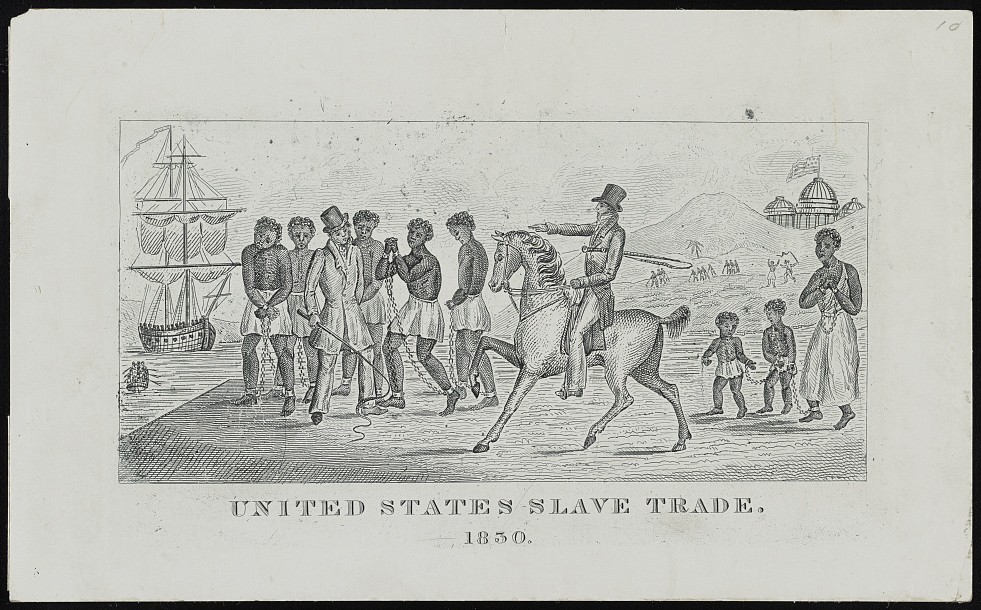
They had no idea how effective their work would turn out to be. Many thought the Republic would last for only a couple of decades. Of course, it has not only lasted much longer but thrived. It has not been perfect, of course. Even the best design for government cannot prevent all error of human judgment. One of the central compromises the Framers themselves made, to put off to the future the issue of abolishing slavery, nearly tore our country and their intricate design for the national government to shreds.
Since we strongly embrace the values on which our system is built, and want to encourage other Americans
So it is valuable to remind ourselves that nothing we are struggling through now compares to the dilemma of slavery, which so dominated the nation’s first seventy years. It is simple for us to look back and say slavery is wrong and the Framers should not have compromised. But the issue for them was far more complicated, both because our age has made the moral judgment about slavery their age was struggling with and because we have the nation they were trying to build.
We have no way to know what would have happened had they refused to compromise on slavery in 1787, or at any of several other moments along the march to the Civil War. Perhaps we still would have one nation. Or perhaps we would have two, both ultimately having abandoned slavery.
Or perhaps the Framers’ greatest fear would have been realized, and America would have become a set of feuding, little republics, preyed on and dominated by the great powers of Europe. History is fun to play “what if” games with. But we do not get to rerun history. All we have is the testimony of the participants themselves.
As this original compromise over slavery – America’s original sin to some – was finally collapsing, Abraham Lincoln reviewed the history and refused to disown the Framers: “We had slavery among us. We could not get our Constitution unless we permitted them to remain in slavery, we could not secure the good we did secure if we grasped for more. And having by necessity submitted to that much, it does not destroy the principle that is the charter of our liberties. Let that charter stand as our standard.”
As we look back across all the years of our history since the Constitution, it is easy to agree with Lincoln that the overall success, the overall good, is far greater than even the horrifying failings. The constitutional system has lasted longer than any other republic in history. But it has not just survived. It turns out that the Framers’ insight — that the self-interest of people had to be the basis around which government was designed — had another larger implication.
Until the American Revolution, the general wisdom was that democracies needed to be limited in size. This was because they relied on each citizen to recognize a shared interest with his fellow citizens and sacrifice some of his own desires to that larger good. Just thirty years before the American Revolution, Montesquieu, the French political philosopher whom all the Framers looked up to, had contended that republics needed to be small to survive.
But by creating a government that encouraged the pursuit of self-interests, the Framers unshackled their new nation from this philosophical restraint. They made America, to use a phrase from our time to describe their invention, scalable. If the clash of ideas and interests would produce better results, they reasoned, then more ideas and more interests would produce even better results. The old need was to limit the size of a democracy to ensure its smooth functioning. They turned the argument on its head to encourage expansion and growth.
Expansion and growth, of course, are just what happened. Americans pursued their interests, and by pursuing their interests they built the nation. As they did this, alternative approaches to government came and went around the world, stared down, in fact, by America with its energy and power.
One of the fundamental differences between those other approaches and the American constitutional system goes all the way back to that sweltering room in Philadelphia. The communists, the fascists, the national socialists all put first the goal of a new and, in their view, better society. Government’s purpose was to enact that better society on behalf of the people.
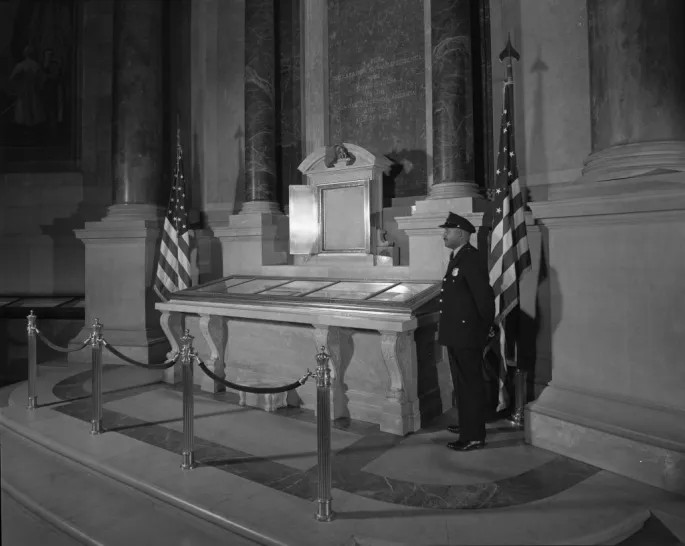
The end was more important than the means. But to the Framers, the better world, which they believed would come, was a byproduct of their government, not its purpose. The citizens would decide in common what that better life entailed. Government’s role, under the Constitution, was to channel society’s conflicts and struggles into a field of battle with rules that protected the liberties of individuals and encouraged compromise. They elevated process over result. The most venerated artifact in all of American history is, remarkably, a document laying out governmental process, “this Constitution for The United States of America.”
While the document is quite short (just over seven thousand words, including the twenty-seven amendments), the process it creates is complicated. Woodrow Wilson, a professor of government before becoming a president, saw it “as too complex to be understood.” But the complexity was no accident. It was designed that way – to make change difficult without consideration and consensus. A simple majority should not get its way, itself a point of departure from most democracies. James Madison was passionate on the point that majority rule was not an adequate test
Despite the role the Framers built for government as an obstacle to rash or speedy change, the American government has, as designed, incrementally allowed much change. Over time, that change has been extraordinary. Since the Great Depression, a forty-year consensus among Americans thrust government from a small participant in their lives to a central player. That consensus produced, for example, Social Security, Medicare, Medicaid and an expansion of civil rights, voting rights and environmental protections. It also sharply increased the expectation among the people that government could solve problems.
But in the last decades of the twentieth century, that consensus unraveled, leaving intact only expanded expectations that government can solve our problems. The country became divided into a multitude of different interests, each demanding that its own policies be enacted into law. Discord now distinguishes the political landscape, fueled by political “leaders” who reason that they can secure their own position by promising to support one interest against another.
As the clamor rises, the government cannot accommodate all these competing demands. Indeed, it was designed to frustrate them. So, naturally, there is great frustration and anger among many of these groups whose demands and expectations have been unsatisfied.
None of this would have surprised or upset the writers of the Constitution. They believed action without consensus was far more dangerous than stasis while searching for consensus. But what might have worried them is how the political frustrations have turned into attacks on the process itself. The values that compose our Constitutional Conscience are meant to reinforce each other. We accept compromise because we feel we are represented in the decision.
But many Americans no longer feel well represented. This is due in part to dysfunctions in the Congress that need to be fixed. But, even more, it is also due to our increasing unwillingness or inability to appreciate a central principle of the Constitution: American government was not established to satisfy our specific wants, but to sort out all our desires and demands and find some common good.
What have you given us? Benjamin Franklin was asked as he left the Constitutional Convention. “A republic, madam, if you can keep it,” he famously replied.
Sadly, Franklin’s warning is no longer too alarmist. We have never been richer or more powerful as a nation. Yet within we harbor deep doubts and divisions that undercut our unity.
A key element of this has been a tendency to blame the process of government, the one the Framers gave us, for our problems. This attitude is corrosive and threatening for the reason Learned Hand, the great jurist, once explained. “Liberty lies in
Our Constitutional Conscience, what we believe in our hearts and minds, is more central even than the document itself and all the rulings of the Supreme Court. Certainly, it is not dead in us. But we do believe it is ailing.
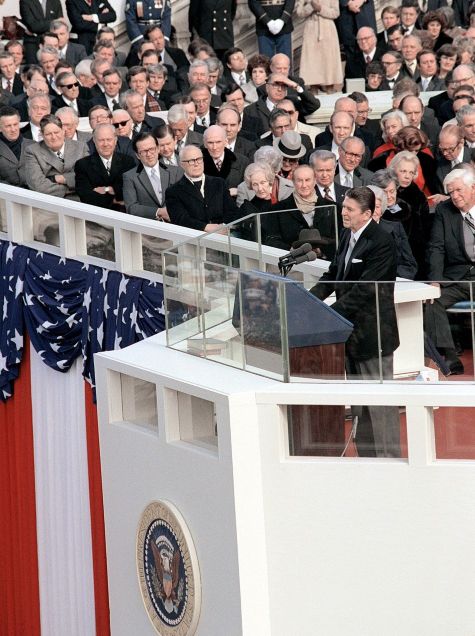
In his first inaugural address in 1981, Ronald Reagan decried the unhappy attitude toward government that rose in the late 1970s. It had been a long journey for Reagan — actor, Roosevelt Democrat, union leader, corporate spokesman, Barry Goldwater advocate, conservative governor of California. Through a lifetime of experience he had honed his view that government needed to be limited. Now he looked out on a nation in turmoil. At home, inflation had sapped the country’s economic will, and the rift of Watergate was still raw. Abroad, for all its power, the nation had been humiliated by an Iranian cleric who after 444 days was just at that moment releasing the hostages he had held in the American embassy in Tehran.
Reagan, speaking for the first time as president, went beyond just the idea that government was too big.
It was an important moment at the outset of what became one of the most important presidencies of the twentieth century. Reagan’s vision of a united American people, blocked from the realization of their dreams by an entrenched political system, signaled the start of what became known as the Reagan Revolution. It is striking the extent to which much of our political debate since then can be traced back to either Tom Paine’s idealistic vision or James Madison’s cold-eyed pragmatism. We are not America without both.
Reagan strongly echoed Paine 205 years earlier. In times of crisis, times that try men’s souls, turn to the People, that breed called Americans, who unfettered by government will have the
Talk of the people strikes a chord in each American because it connects to the story of the American Revolution as we receive it in school. But the call to the people leaves out half the history of the Revolution. When Reagan set the people as the antithesis of the government, he was returning to the spirit of 1776. But the story of 1776 is incomplete without the story of 1787 and the writing of the Constitution, which rescued the heroism of 1776 from the dustbin of history.
Whereas 1776 was the triumph of liberty, 1787 was the triumph of a new wisdom that to preserve liberty there must be a process for making choices and taking action. That process is laid out in the Constitution. The Constitution’s writers drew their government’s authority from the people, and from nowhere else. But they also rejected, quite clearly, the notion that the people could, mystically, solve the nation’s problems without a process of government to bring them together. Their own experience had violently disabused them of that notion.
As Reagan spoke, the men behind him representing the majority leadership of the House of Representatives and the Senate were Democrats. So his words about rule by an elite group might have been understood as a bit of political hyperbole meant to suggest that the problem was the specific people or party in control of the government just then. But this would be to miss the much larger antigovernment sentiment gathering strength in those years among Democrats and Republicans, left and right, a force that carries forward to this day.
Two years before Reagan was elected president, the voters of California adopted a proposition, number 13 on that year’s ballot, to limit the spending authority of their legislature. This reinvigorated a process, initiative and referendum, that allowed Americans to vote directly on issues and circumvent their state legislatures (or even the Congress under a version now being pushed by former U.S. senator Mike Gravel). That is, philosophically, exactly the opposite of the view of the Framers, who gave process a central role in their vision of democracy.
This historical context would not have occurred consciously to many of the spokesmen for the gathering effort to take power from government. Reagan believed profoundly in America, and one of his important contributions was a revival of what he called “informed patriotism” steeped in an understanding of our history. Certainly, Reagan would not have accepted the idea that he was arguing across the
But there were those who explicitly acknowledged that they wanted to undo what the Framers had invented. A few months before Reagan took office, in the frustrating final days of Jimmy Carter’s presidency, Carter’s counsel, Lloyd Cutler, a consummate Democrat, called for the scrapping of the essential elements of the process created by the Constitution. “Whatever its merits in 1793, American Government has become a structure that almost guarantees stalemate.” He proposed a Parliament whose members would be more responsive to the president.
We can see from the perspective of forty years later that Reagan’s analysis of government as the problem and Cutler’s call for the abolition of the independent Congress were just the beginnings of a period of stalemate in America and consequent frustration.
It is an irony of our age that one of America’s greatest triumphs, one of Reagan’s greatest triumphs, the collapse of the Soviet Union, coincided with a growing disillusionment at home with the American process of government, the very process which has proven so much more resilient and lasting than any of its competitor systems.
To maintain the essential legitimacy of democracy, government must ultimately respond to the demands of its people. But America’s government is designed to slow such response, to resist, as Hamilton put it, “an unqualified complaisance to every sudden breeze of passion, or to every transient impulse.” This inevitably creates tension between the people and their government.
This tension has intensified as the country’s politics have fractured. We are living through “the growth of a politics based upon narrow concerns, rooted in the exploitative division of class, cash, gender, region, ethnicity, morality and ideology — a give no quarter and take no prisoners activism that demands satisfaction and accepts no compromise.” In other words, a period of strife and disunity much like the early days of America out of which the Framers invented the process of government in the Constitution.
Faced with the growing divisions of our age, Congress has done less, just as the Framers designed it to do. The result is ever-growing criticism of the government as an obstacle to change. People of all ideological and political stripes, frustrated by government’s incapacity to provide what they want, have found common ground in blaming the design of the government for their failure to get their way.
But the fault, to paraphrase Cassius, is not in the government (or at least not only in the government). The government is doing what the Framers designed it to do when a divided country “accepts no compromise.” It is waiting for compromise to seem more palatable than political warfare.
Americans are always free to reject what their forefathers bequeathed them. The South tried that once. The Constitution ingeniously includes a process for its own amendment, which could even
Many Americans talk as if they want that now. “Power to the people,” a term coined by the left during the 1960s, has now become a slogan for disaffected groups of all political stripes. Their question is, why should we have a government that frustrates the demands of so many people?
America’s greatest strength and greatest weakness are the same thing. We are not burdened by a sense of history, our own or anyone else’s. Our sense of the past is, to be polite, thin and growing thinner. The evidence for this is all around us. We opened this essay with the third stanza of “America, the Beautiful” to make the point. Everyone knows the first stanza, with its appeal for God’s grace and brotherhood. But virtually no one knows this later stanza, which honors the core idea of our Constitution. Our detachment from history has liberated us as Americans to focus forward. We look to the future in a way that many other societies envy. But it can also disconnect us, as is the case now, from an understanding that would comfort and guide us.
The Framers did what they did for carefully thought out reasons. Their choices made sense then. We think understanding them better would help us understand our present predicament better. To do that, we need to revisit the most important eleven years in American history. Those are the years from 1776, when the colonies declared themselves free and independent, to 1787, when a group of men gathered in Philadelphia and, as William Bennett summed it up, “devised the most miraculous political document in history just as the young nation seemed to be falling apart.”
An extraordinary intellectual revolution took place in the minds of America’s leaders during those years. In 1776, most of them believed that self-interest was a threat to democracy, but that Americans, free of England, would rise above their self-interests to create the new nation. By 1787, they had changed both ideas. They recognized that while America was a special land, Americans were like everyone else, motivated by their own interests. But they could still make their new nation work by reinventing democratic government to channel those self-interests into the larger good.