Authors:
Historic Era:
Historic Theme:
Subject:
Spring 2026 | Volume 71, Issue 2


Authors:
Historic Era:
Historic Theme:
Subject:
Spring 2026 | Volume 71, Issue 2


A private pilot named Kenneth Arnold kicked off a worldwide craze when he claimed he saw a string of shiny saucers fly past Mount Rainier in 1947.
Spring 2026 | Volume 71, Issue 2
Editor's Note: Mike Bezemek is a journalist and the author of Mysteries of the National Parks: 35 Stories of Baffling Disappearances, Unexplained Phenomena, and More, published by Sourcebooks in 2025. The following essay comes from chapter one of the book.
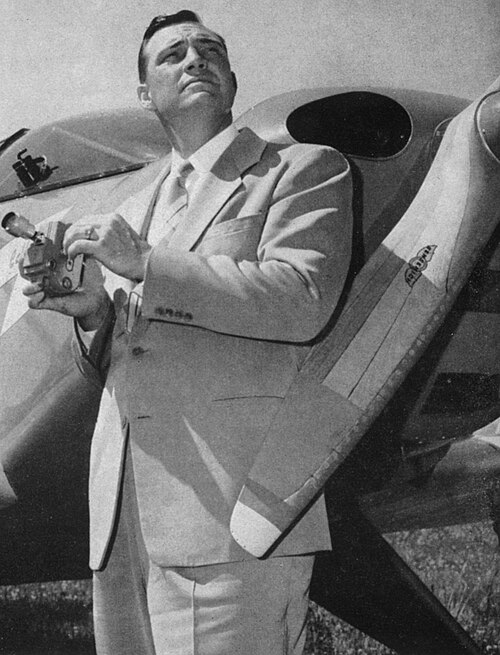
Through the cockpit windows, the snowy hulk of Mount Rainier dominated the horizon. A private pilot was steering his two-seat prop plane toward the 14,411-foot dormant volcano. Along the way, he studied the southwest slopes for wreckage. The previous winter, a U.S. Marine transport plane carrying thirty-two servicemen had vanished in a storm. When the weather cleared, there was no sign of the plane, which presumably had crashed into the mountain and been buried by snow.
Now, it was a sunny afternoon in late June 1947. The pilot’s name was Kenneth Arnold, and he was flying solo on a short hop from Chehalis to Yakima for a business trip. Back home in Boise, Idaho, Arnold was an experienced search-and-rescue volunteer who had learned about a $5,000 reward for locating the lost plane. After two unsuccessful flybys, he was about twenty miles west–southwest of the summit when he banked toward the mountain for the cabin.
Suddenly, a blinding flash illuminated the cabin. Arnold scanned the sky, worried he might be on a collision course with another plane. All he saw was a silver DC-4, far off to the southwest, heading toward Seattle. Then he noticed another flash coming from the north in the direction of distant Mount Baker. A chain of nine bright objects was flying south at incredible speed.
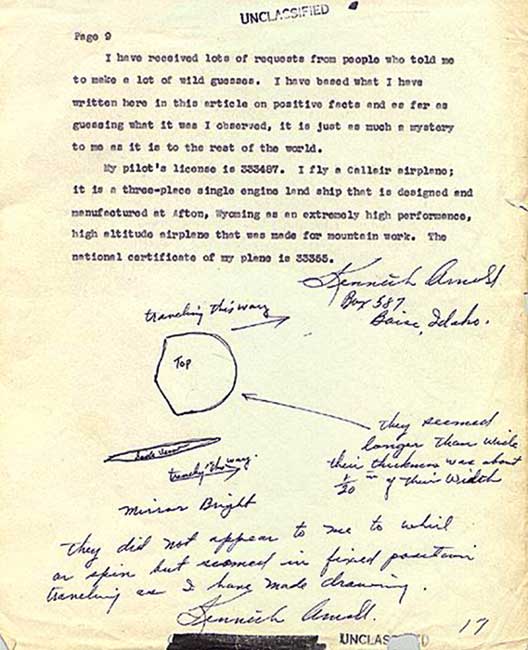
As the strange objects approached, Arnold tried to comprehend what he was seeing. They flew in an echelon, a roughly diagonal formation often seen with military planes or geese. But the shapes seemed too big to be birds, perhaps comparable in size to the distant DC-4. They were also moving faster than any aircraft known to man. Despite maintaining the formation, each individual vessel flew erratically. They fluttered and tipped their wings, which flashed reflections of the sun.
As these skittering objects passed in front of Mount Rainier, Arnold noted their silhouettes. Each was shaped like a crescent moon with a convex triangle protruding from the rear, somewhat like a boomerang or the later flying wing. When viewed on edge, they seemed improbably thin. What most surprised Arnold was that he couldn’t spot any vertical stabilizers. Were these experimental military jets with camouflaged features?
Using the clock on his instrument panel, Arnold timed the formation as it traveled from Mount Rainier past Mount Adams, more than forty miles to the south. One minute and forty-two seconds. Once the objects were out of sight, Arnold gave up