Authors:
Historic Era:
Historic Theme:
Subject:
Summer 2026 | Volume 71, Issue 3


Authors:
Historic Era:
Historic Theme:
Subject:
Summer 2026 | Volume 71, Issue 3


Sixty years ago, as James Meredith fell to his knees in Mississippi, the civil rights movement found itself at a turning point.
Summer 2026 | Volume 71, Issue 3
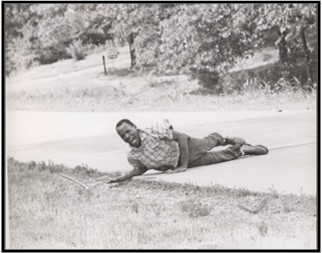
Hit the dirt! The cry came at 4:15 p.m. on June 6, 1966, just before three shotgun blasts exploded from the bushes along Highway 51 near Hernando, Mississippi. Two of the rounds found their target: James Meredith, a 32-year-old black law student who had the day before embarked on a protest march from Memphis to Jackson, Mississippi. Sixty years ago, as Meredith fell to his knees on the ground, the civil rights movement found itself at a turning point.
In 1962, Meredith had been the first black student to attend Ole Miss, another in a line of desegregation victories stretching back to Brown v. Board of Education in 1954. But now the unity of those early years was dissolving. The next three weeks would show the world just how much.
Four years had passed since Meredith had applied to transfer to the all-white University of Mississippi at Oxford. When the university rejected him despite his high grades, a federal court ruled that he could not be denied admission based on the color of his skin. Even so, the governor of Mississippi took it upon himself to travel to the campus in person that September to keep him from registering. President John F. Kennedy had to order in 500 federal marshals and 5,000 army troops to disperse a racist mob that gathered outside Meredith’s dorm. A riot on September 30 killed two bystanders and injured 168 marshals before the army overwhelmed the outraged Mississippians. Meredith, protected by armed guards, endured a year of threats and harassment before graduating in August 1963.
Now, in 1966, Meredith was attending Columbia Law School in New York on scholarship, but he remembered the terror he had felt in Oxford. He decided to conquer his fear by marching through Mississippi. He hoped his example would help Mississippi’s 450,000 disenfranchised blacks confront their own anxieties and register to vote: “If I can do it, maybe they can, too.” An iconoclast and a loner, he chose not to invite any civil rights groups to join him. “I didn't want a crowd of people to go into rural Mississippi and become a burden upon the Negroes in the area,” he explained. “This is crop-planting time.”
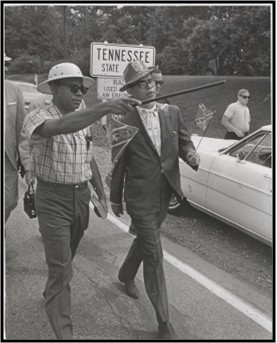
Unarmed, accompanied only by six friends, and carrying a Bible and an ebony cane, he set out from Memphis on June 5 on his March Against Fear. Just three years after the assassination of Medgar Evers and two since the