Authors:
Historic Era: Era 5: Civil War and Reconstruction (1850-1877)
Historic Theme:
Subject:
Summer 2026 | Volume 71, Issue 3


Authors:
Historic Era: Era 5: Civil War and Reconstruction (1850-1877)
Historic Theme:
Subject:
Summer 2026 | Volume 71, Issue 3


The extravaganza celebrating the nation’s first century was the greatest cultural event of America’s Gilded Age.
Summer 2026 | Volume 71, Issue 3
Editor’s Note: Fergus M. Bordewich is the author of ten books of history. Portions of this essay appeared in his recently published book, Centennial: The Great Fair of 1876 and the Invention of America’s Future, which looks at the great exhibition and the converging crises that the United States was facing during its centennial year.
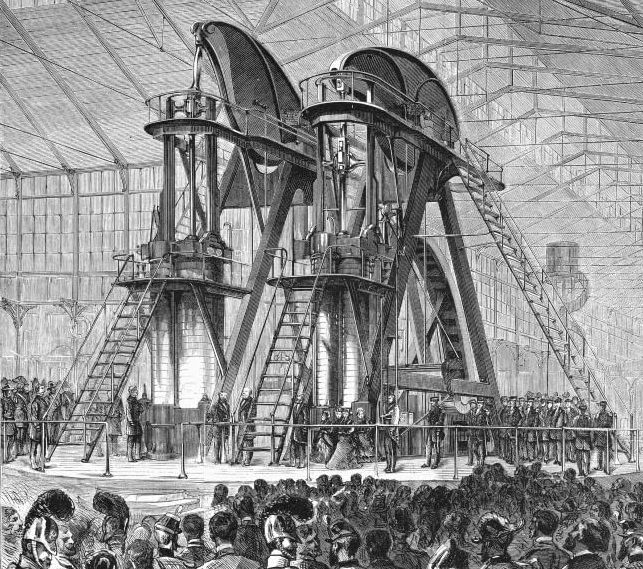
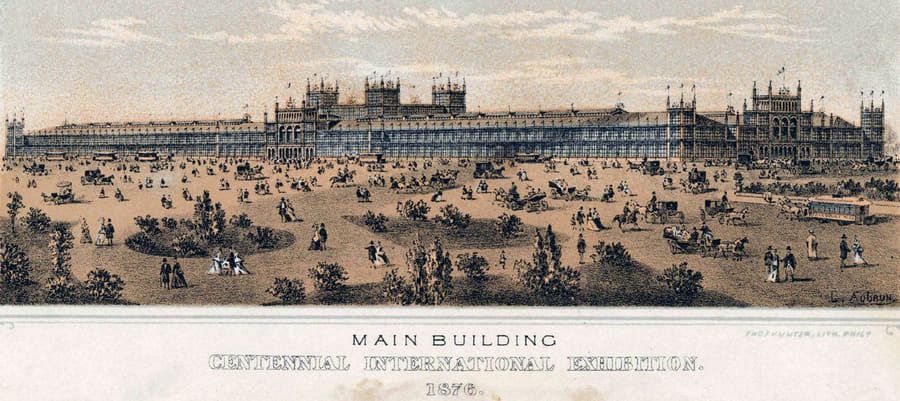
On the morning of May 10, 1876, Ulysses S. Grant stepped from his overnight quarters on Walnut Street in downtown Philadelphia to be greeted by an escort of brass bands, massed sailors and soldiers, cavalry in horse-tailed helmets, admirals and generals, governors and Supreme Court justices, magnates of industry, politicians of every rank and stripe, foreign ambassadors, and the president’s guest of honor, the emperor of Brazil, Dom Pedro II. They were the advance guard of the most spectacular public extravaganza to be mounted in Gilded Age America, the long-anticipated celebration of the nation’s first Centennial, a figurative stone’s throw from Independence Hall, where the Founding Fathers had signed the Declaration of Independence.
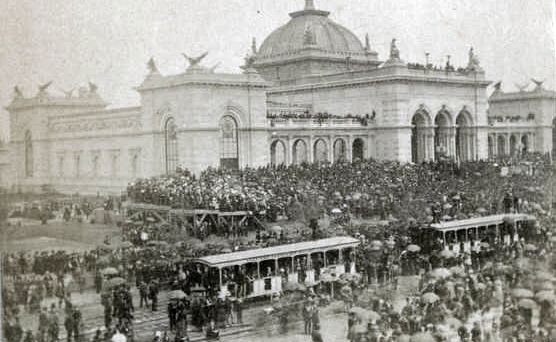
In carriages, on horseback, and on foot the festive cavalcade processed along streets festooned with patriotic bunting and the flags of all nations, through roaring crowds of men, women, and children to Fairmount Park, two miles to the north, which a year’s labor had transformed into a theater of national glory, vaster and grander than anything ever before seen in America.
At the park, Grant and his entourage mounted a giant stage to face a crowd that numbered at least 100,000 and perhaps twice that, packed so densely that it was difficult to move without the aid of police. Boys slack-jawed with excitement perched on statues of the Muses. Bishop Matthew Simpson offered thanks to God for the nation’s prosperity and progress, for the courage of its Founding Fathers, and for the labor-saving machinery that eased the lives of the toiling masses. An orchestra of 150 musicians played “La Marseillaise, “God Save the Queen,” the anthems of Brazil, Germany, Russia, the Netherlands, Spain, and a dozen other powers, followed by a march for the occasion composed by Richard Wagner. A thousand-voiced chorus next sang the official “Centennial Hymn” penned by the aged John Greenleaf Whittier.
At last, the president rose. Grant was a man of modest height, more portly than when he ascended to his office seven years earlier, his chestnut hair beginning to go gray. In big gatherings he